


Showing posts with label Teaching. Show all posts
Showing posts with label Teaching. Show all posts
Friday, November 21, 2014
How to say 'I am Groot' in 15 languages


Marcadores:
Groot,
languages,
Marvel,
Teaching,
Translation
Wednesday, November 19, 2014
Idiomas sem Fronteiras: Brazilian Government special program for language learners

Good News for all language learners and teachers in Brazil. The Brazilian Government has launched a program called 'Idiomas sem Fronteiras' (something as 'Languages without borders') that aims at linguistic development of college students, professors and also language teachers at public schools. The program will offer on-line classes and possibly the opportunity for an exchange experience. Besides English, the program includes French, Spanish, Japanese, Mandarin, Italian, German and also Portuguese for foreigners students.
For more information, check the link:
Marcadores:
Education,
English,
Idiomas sem fronteiras,
News,
Teaching
Friday, May 9, 2014
Brazilian students learn English with elderly American

Marcadores:
CNA,
elderly,
Teaching,
Teaching Strategies
Thursday, May 8, 2014
Song & Lyrics: Fifa World Cup Brazil 2014 Official Song

I commented on previous posts how controversial the Fifa World Cup in Brazil is. Anyway, there's less than one month left, so I guess we should take the most we can out of it as a learning opportunity. One thing that always can help is the official song, which this time is sung in English and Portuguese, and with a very positive message.
The song is performed by the legendary Mexican guitarrist Carlos Santana, the Swedish DJ Avicii the Haitian-American Wyclef Jean and the Brazilian Alexandre Pires. The song title "Dar um jeito" is a very coloquial expression that reflects the positive feeling Brazilian people usually have, even when against the odds of living in a nation not fully mature in many aspects. Check it out:
Dar um Jeito (We wil find a way) lyrics
Dar um jeito (oh oh oh)
Dar um jeito (oh oh oh)
When you got nothing to eat
And you find it hard to sleep
How you struggling on the streets
And you can't escape the heat
But your heart could feel that beat
So you get up off your feet
Ain't no mountain you can't reach
Grab a star and make a wish
We're celebrating and we're wavin' all our wrath
We are united even though we're different flags
We are one voice, one heart
One soul, once we set that goal
You know we're gonna start
Here we go, oh oh oh
That's all we know oh oh oh
So here we go, oh oh oh
That's all we know
Dar um jeito (oh oh oh)
We gonna find a way, yeah we gonna find a way
Dar um jeito (oh oh oh)
We gon find a way, yeah we gon find a way
Você nasceu pra brilhar
Está escrito em seu olhar
É tão forte a sensação
De vestir uma nação
Quando o jogo começar
Ninguém vai te segurar
Sua determinação
É de um grande campeão
E nós celebramos e vibramos por vocês
O mundo inteiro está torcendo outra vez
Nós somos uma voz, corpo e alma
Coração, então vamos gritar
Explode a emoção
Here we go, oh oh oh
That's all we know oh oh oh
So here we go, oh oh oh
That's all we know
Dar um jeito (oh oh oh)
We gon find a way, yeah we gon find a way
Dar um jeito (oh oh oh)
We gon find a way, yeah we gon find a way
Here we go
Here we go
Here we go, oh oh oh
That's all we know oh oh oh
So here we go, oh oh oh
That's all we know
Dar um jeito (oh oh oh)
We gonna find a way, yeah we gonna find a way
Dar um jeito (oh oh oh)
We gonna find a way, yeah we gonna find a way
Here we go
Marcadores:
Brazil 2014,
official song,
resources,
Song & Lyrics,
Teaching
Wednesday, August 7, 2013
Valuable distinctions in ESP

I’ve always
heard about English for Specific Purposes (ESP) but it was only recently that I
got acquainted with two important distinctions on this field. I’m talking about
two concepts that are very valuable to every teacher/instructor on this
context: English for Academic Purposes (EAP) and English for Occupational
Purposes (EOP).
English For
Academic Purposes
As the name
suggests, it focuses on the preparation of students who are about to start a
course in an Academic Field. It involves not only the languages skills, like
specific vocabulary, but also key abilities related to common activities in any
Academic Situation, such as writing reports, taking notes, raising questions and
doing formal presentations, that are directly linked to the students’ academic
success.
English for
Occupational Purposes
It’s more
like a training on some very specific language that is going to be demanded on
a professional situation. It can take place prior to work or in service. It
tends to be a really practical approach focusing on students' realistic and immediate needs.
These two distinctions are really key for teachers designing a course and who needs to have a clear view of its goals in order to estabilish realistic and achievable goals.
You may also like:
Monday, January 21, 2013
Learn English with the Premier League
Now that you know the difference between soccer and football (read more here), why not trying to learn a bit more with it?

Click here and check out the "Premiere Skills" website, which is developed by the British Council and brings lessons about all the football (or soccer) clubs in the Premier League, the competition with important teams such as Arsenal, Chelsea, Liverpool & Manchester United.

You can learn a lot of specific vocabulary with interactive games and very nice materials including audio and video.
Very nice stuff for teachers and learners, and maybe even for coaches and players!
You may also like:
Marcadores:
English,
football,
Premier League,
resources,
soccer,
Sports,
Teaching,
Vocabulary
Saturday, November 24, 2012
Black Friday in Brazil?
Isn't it funny how some things are artificially created and in a moment they seem plausible to everyone?
One thing that really gave me some food for thought this weekend and even raised a good discussion with a group of students was the number of stores in Brazil advertising their "Black Friday" sales.
 |
| Some of the Brazilian Black Friday ads |
"Black Friday", if you're not aware of it, is the traditional day of sales in the U.S. that follows the Thanksgiving Day, celebrated on the 4th Thursday in November, and it's also the beginning of the Christmas Sales Season and a really big deal. (you can read more about it by clicking here).
But what happens in the Brazilian version is a joke in bad taste. First of all, we don't celebrate the Thanksgiving Day in Brazil (except for immigrants, language schools and maybe some religious groups originated in the US). Secondly, the sales day is just a marketing strategy to sell products for their normal value, once their prices are usually inflated. So, there's no tradition and no good deals.
I asked lots of people, including my students, about the "Black Friday" ads on tv and on the Internet and they didn't have the least idea of what it was about (of course, they guessed it was about sales, but the big question was "Why Black Friday?").
As an English language teacher, I really thinks it's funny to learn about these holidays and festivals, and even take part on them in the context of cultural learning. But when it becomes something strictly commercial things get really weird.
Do business people need another great sales day? Ok, that sounds fair enough. But please, try to do something more meaningful and respectful next time...
You may also like: Why is English in the news in Brazil?
Marcadores:
Brazil,
culture,
opinion,
reflection,
Teaching
Monday, November 19, 2012
Learning English with the American Election
A few weeks ago I asked my students, all 7th graders in a regular school, to make their own posters using the 'Election vocabulary' we had previously studied. In order to do that, they had to choose their own candidate (a celebrity but not a politician), a name for his/her party and a slogan for their campaign.

It was a very simple but funny task and the kids really enjoyed it. Moreover, they could learn a bit more about the American elections as all the "Obama Vs Romney" hype was going on at that moment.

Would you vote for any of these candidates? Maybe Einstein could be a good choice...
You may also like: Mobile Phones in The Classroom
Marcadores:
Elections,
Experience,
Learning,
students,
Teaching
Saturday, October 20, 2012
The Ducks Go Gangnam Style (or 'what's meaningful learning?')
When I got back from Oregon after taking part on the ELCP course (read more here), one of my first actions was to talk to my students about the experience of living in the US and studying in an American University.
And, of course, I couldn't talk about the University of Oregon without mentioning "the Duck", the symbol and mascot of UO football team. The kids loved that and all the stories that followed.
That was six months ago. But, to my surprise, last Friday, the 'duck' subject arose again. One of my students come to me saying 'hey teacher, do you remember the Oregon duck you talked about? I saw it dancing 'Gangnam Style!'.
 |
| Psy and the Duck: who has more style? |
At first it sounded like an hallucination and I thought to myself 'what's this boy talking about?', but he explained before I could ask: he had seen a viral video on the Internet featuring the Oregon Duck performing the song 'Gangnam Style', an international mega-hit by the Korean pop singer PSY.
So, what's all of this has to do with teaching or learning? Well, in my view what we call 'learning' is the capability of making connections between different aspects of our experience as 'living thinking beings'. Some connections are really obvious, and based on that, we teachers create our expectations over our students as a minimum curriculum. But some connections go beyond our expectations, which leads to the creative thinking. Of course, this happens on a very personal level, but the quality of the 'input' we offer to our students is crucial for that. The more diverse this input is, the more creative can these connections be.
And then we have marvelous (maybe miraculous...) coincidences like this: a singer in Korea has this song that happens to be a worldwide phenomenon; it echoes on an Oregonian mind who comes up with this parody, that's heard and seen in a small city in the countryside of Brazil by a young boy, who had previously learned about the Oregon Ducks from his teacher and talks back to him, who's now writing about this and coming up with some ideas for a lesson plan, which means that the echo will go further and, therefore, more connections will be made.
By teaching, we learn. By learning, we teach. Both ways we make connections; both ways we get connected...
You may also like: Lyrics that aren't lyrics
Sunday, October 14, 2012
What does it stand for? Acronyms and Abbreviations in English
When teaching or studying ESP it's very common to come across with a lot of abbreviations and acronyms .
An acronym is "a word formed from the first letters of the words that make up the name of something" (that's how it's defined by OALD, or Oxford Advanced Learners Dictionary).
And in this era of micro-blogging and fast written communication, more and more acronyms are created everyday (just have a look on Twitter's "TT" (Trending Topics) and you'll see that).
In the business area, acronyms are usually an important part of the professional jargon.

'What does it stand for?'
Take a look:
'What does ESP stand for?'
'It stands for English for Specific Purposes'.
Some acronyms can make the answer to this question quite complicated. That's why it's very helpful to have some resources at hand. Besides the traditional Google search engine and the online dictionaries, there are some websites like acronymfinder.com, acronymsearch.com and abbreviations.com.

But take care because an acronym can have lots of different meanings.
For instance, I looked for "ESP" in abbreviations.com and got over a hundred definitions!

TAFN. TA. SYS!
(That's all for now. Thanks a lot. See you soon!)
You may also like: 5 tips for ESP teachers
Beyond Google Translator
Sunday, October 7, 2012
PBS: Positive Behavior Support
Have you ever given any kind of reward to your students for an accomplished task? What about giving them a prize for a positive attitude they had?
 |
| Behave well and get the Prize |
Marcadores:
Approach,
Education,
ELCP,
PBS,
Positive Behavior Support,
strategies,
Teaching,
UO
Tuesday, August 28, 2012
Why is English in the news in Brazil?

'Veja', one of the most popular weekly magazines in Brazil, has dedicated its cover story this week to discuss the importance of learning English for a successful career in different areas.
In order to do that, the story presents some people reporting the problems, benefits and difficulties they had while trying to learn English. It also brings some basic tips about how to deal with false friends and even a Language quiz.
But behind of all the usual stuff there's this uneasy data showing that, generally speaking, the Brazilian results on international English exams are poor.

That's not surprising, if we consider that Education as a whole in Brazil has a lot to improve. We still lack maturity in many aspects. Believe it or not, even today we can find teenagers who underestimate the value that learning English could add to their formation. They rely on technology, like Google Translator, for their basic everyday needs and don't seem to care about communicating effectively. Maybe that's the reason why Veja's story emphasizes that adults still can succeed on language learning. Adults surely understand what our kids don't.
Now that Brazil is economically stronger and about to hold the Fifa World Cup and the Olympics, there's this increasingly worry about the lack of qualified personnel who can really communicate in English.

And that's how the topic became a cover subject. Many companies have to invest in their staff, but we all know that learning a language takes a little time. And on business, time means productivity and profit.
For us teachers all this situation might mean great job opportunities, but it also means a lot of hard work.
Saturday, August 18, 2012
English Language Certificate Program for Brazilian Teachers

 |
| Chalk Talk during a teaching workshop |
I also had the chance to learn a little about the North American Educational System, visiting public schools and talking to American principals and teachers, which undoubtfully broaden my view on Education in general.
And of course, there are all these wonderful people I had the privilege to meet: the great UO staff, the other international students, the friendly Eugenean people and my unforgettable Brazilian fellows.
On my next posts, I'll share a bit of what I learned during the program.
And to give you a glimpse of what it was like living in Eugene, Or and the effect this experience had over me, I'll leave you with two songs.
The first one, "Back in Eugene", which I wrote the day after my arrival back to Brazil, is about how I was feeling (actually, how I still feel...) about everything that had happened.
The second one, called "Sweet Eugene", had its lyrics written by a fellow participant (Mr. Flávio "Nickel Noisy", who has a very nice blog about English Language and Culture that you can check by clicking here) and I was given the opportunity to turn it into a song whose result I'm really proud of. It is about our routine and all the places we could visit during our stay in Eugene.
Enjoy it!
Marcadores:
Back in Eugene,
Education,
ELCP,
Experience,
Opportunity,
Sweet Eugene,
Teaching,
University of Oregon,
UO
Saturday, August 4, 2012
Managing your classes with a free app for Ipad
Looking for a tool that can help you to manage your classes? So I strongly recommend that you check the 'Teacher KIT' FREE app for Ipad.
Previously known as "TeacherPal", the app was renamed after its last update, but it still keeps the same functionalities as described bellow.

Previously known as "TeacherPal", the app was renamed after its last update, but it still keeps the same functionalities as described bellow.


Once you have created your course timetable and registered your students, you can take attendance by simply clicking on the icon with the students' name or picture (yes, there's this very nice feature that allows you to add students to their profiles).
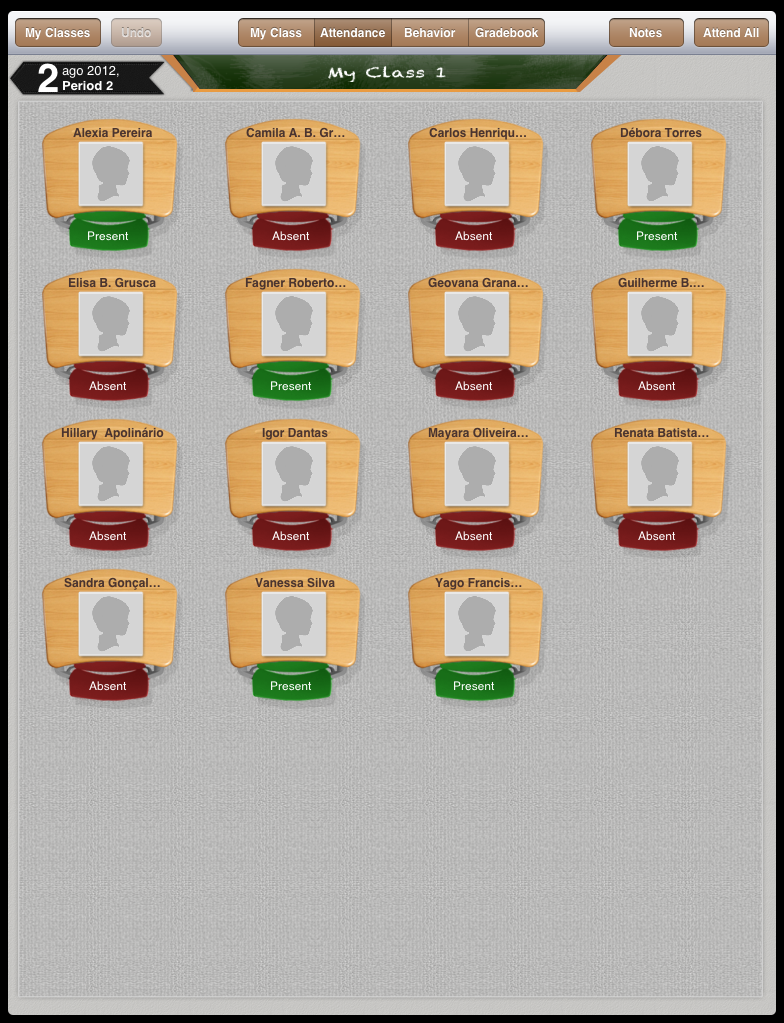
It's also possible to include students or parents contact information.
You can establish grades and their weights. And if you're worried about losing this important data, you can at anytime upload it to Itunes or send a report with the details to your email, on a spreadsheet that the app automatically generates.

If you teach private classes and have to manage your own groups, 'Teacher Kit' is really worth a try.
Check out this video for more details:
Marcadores:
app,
Education,
Ipad,
Mobile Learning,
Teaching,
technology,
tools
Tuesday, July 3, 2012
Mobile phones in the classroom
 The idea was to use the students own mobile phones to record themselves asking and answering some questions based on a reading activity they had previously done. It was also part of a project I developed while taking part in the English Language Certificate Program at the University of Oregon, in Eugene/Or during this winter.
The result was satisfactory for a first try, although I need to work a lot more on the methodology.
Check out this video with images of my students performing their tasks:
And I hope you like The Ramones...
***
Unfortunately, due some copyright issues with the song "Rock'n'roll High School" (performed by The Ramones) which I used as a soundtrack for the video, it's not available to mobile devices, which is a great irony. I also can't make any changes on the video, except for deleting it. I apologize for that. The video is really funny.
And youtube, you're not a punk rocker. =/
Marcadores:
Bring your own device,
BYOD,
Classroom,
Education,
English,
Experience,
Methods,
Mobile Learning,
Pedagogy,
project,
students,
teacher,
Teaching,
technology,
video
Sunday, July 1, 2012
Beyond Google Translator
On my previous post about ESP I mentioned Google as a possible resource for everyone looking for specific vocabulary. You can do what most people do, and simply Google a term for definitions or images that illustrate what you're trying to understand, and obviously, you can also use the Google Translator.
 Many of my students go straight to last option, just to find out what we teachers and all the other more experienced learners already know: Google translation technology is really cool, but when it goes to more specific language things don't work that well.
A good alternative to Google Translator is a very useful tool called Linguee. Basically, it's very similar to other online dictionaries or translators. But there's one huge and essential difference: when translating a word it gives you different extracts taken from the web, so you can actually see the word in different contexts.
Here we have a comparison between these two tools: I wanted to know the meaning of term 'piggyback' when applied to Logistics.
Google Translator showed the following results in Portuguese: "over someone's shoulder"; "to put". As you can see, there's no reference to transport or Logistics.
 |
| Google Translator: just the most obvious results |
Linguee results were a lot more interesting: it showed the most common meaning ("over someone shoulders"), but it also furnished the result that was exactly what I was looking for: "railroad combined transport".
 |
| Linguee: words in context |
Of course, Linguee won't solve all the problems, but it can be a very useful tool for ESP teachers and students, translators or anyone who has to deal with specific terminology.
Marcadores:
comparison,
English,
English for Logistics,
English for Specific Purposes,
ESP,
Google,
language,
Learning,
Linguee,
resources,
strategies,
Teaching,
technology,
Translation,
Translator
Monday, June 25, 2012
5 tips for ESP teachers
 Teaching ESP can be quite challenging, especially when you're not familar with the area of study which you're supposed to teach.
Dealing with the techinal jargon that refers to complex concepts is probably the worst part.
If you're facing this situation, here are some ideas based on my own experience:
1. Be clear about your role as a facilitator:
Students must be aware that you're a language teacher and not a specialist in the area. This can help you to avoid creating wrong expectations or future frustrations.2. Look at yourself as a permanent learner:
Teaching ESP can make even experienced EFL teachers stop and study (more than we usually do) while preparing classes. This can help the teacher to understand what kind of difficulties the students are about to face.3. Try to establish a partnership with other teachers or professionals:
Having someone you can rely on and help you to understand the concepts of their area of study can make your life a lot easier and give you more confidence about the subjects that you're teaching and also clarify the real needs of the students.4. Have good online resources and strategies:
As for everything else in this digital world, Google is a very useful tool. Looking for images of machinery, for instance, has helped a lot to understand what they do and how they work. Another useful procedure is bookmarking the websites you found interesting. Do this on a regular basis and soon you'll have a good reference list.5. Be persistent:
It might drive you crazy in the very beggining, but it's just a matter of time until you have created your activities or designed your course. Once you have done it for the first time, things won't be that difficult anymore.***
(Do you have anything to add to this list? Leave a comment!)
Sunday, June 17, 2012
Using mobile devices in the classroom
A week ago, the British educator Steve Wheeler posted on Twitter the following crucial question:
Maybe it's just a matter of time as we're still learning how to deal with all this tech issues, but by now we should have something else than just this talk of the potential of technology on Education.
In the Brazilian case, I'd say that we have bits of technology and even smaller pieces of pedagogy. Yes, we have a few computers at our schools and the students have their own gadgets, like smartphones, but I haven't seen it at work the way it should. In São Paulo, for instance, there's a State law forbidding the use of mobile phones in schools. But what if a teacher could create a learning situation in which a mobile gadget would be useful? Isn't it a paradox that they don't allow the use of the most common and handy device and still claim that more technology should be part of the school routines? Of course, there are many reasons Mobile Phones can cause trouble in the classroom, but the fact is that the students do bring their mobiles, even though they're not allowed. So, why don't we use them?
On this direction, there's this BYOD (bring your own device) trend, which I've been looking at with some enthusiasm. And I gave it a first try this past week. I asked my students at the public school where I teach to record themselves and a classmate saying a few sentences out loud. And to do that they had to use their mobile phones. I even recorded myself saying the sentences out loud and shared the file from my mobile to theirs via bluetooth technology. It wasn't the most revolutionary thing in the world but it worked. It was a pretty cool class.
And yes, I'm sorry that I broke a State law...
We have the technology. Do we have the pedagogy?My answer to this question would be 'no', although we're struggling hard to find it. And as far as I can see reading blogs & tweets on the web, this is a global concern.
Maybe it's just a matter of time as we're still learning how to deal with all this tech issues, but by now we should have something else than just this talk of the potential of technology on Education.
 |
| No Mobile Phones allowed in São Paulo - Brazil |
In the Brazilian case, I'd say that we have bits of technology and even smaller pieces of pedagogy. Yes, we have a few computers at our schools and the students have their own gadgets, like smartphones, but I haven't seen it at work the way it should. In São Paulo, for instance, there's a State law forbidding the use of mobile phones in schools. But what if a teacher could create a learning situation in which a mobile gadget would be useful? Isn't it a paradox that they don't allow the use of the most common and handy device and still claim that more technology should be part of the school routines? Of course, there are many reasons Mobile Phones can cause trouble in the classroom, but the fact is that the students do bring their mobiles, even though they're not allowed. So, why don't we use them?
 |
| A student using her own device during the English class. |
And yes, I'm sorry that I broke a State law...
Thursday, June 7, 2012
My Turn...
 This is my first English book from when I was a 5th grader (1988, I guess...). It was very simple and even a bit silly, but back to those days when the kids didn't even dream about all these eletronic gadgets (the further our minds could go was an 8-bit Nintendo...) it made a lot of sense.
For instance, there was a 'memorable' lesson about 'Beto', an old speaking Volkswagen...
However, my point here is that this book was a lot closer to the Vygotsky's PDZ (Proximal Development Zone) concept than the materials we use nowadays, especially those designed to be used in the Brazilian Public Schools, which are so full of ideology but most of the time too deep for their target audience...
Another thing about this book is that, for me, it was the beggining of everything. Actually, for a long time it was the only material I had for language learning. I studied in a public school, but we had to pay for the books, which were VERY expensive. I remember my mom paying for them in instalments... Anyway, I would see another language book only 7 years later, when I was 18 and finally got a job to afford an English Course.
But that's another 'turn' on the story...
Marcadores:
memories,
Motivation,
Teaching,
Vygotsky,
ZPD
Subscribe to:
Posts (Atom)